23 June 2024

16 April 2023
08 September 2020
Present continuous: spelling, negative statements, yes/no questions
Hello!
Here's a present continuous worksheet that you can use for self-learning as answers are included. Or you can use it in the classroom if you're looking for a review of the present simple. There are four activities in total:
A: spell present continuous form of 20 verbs
B: rewrite 10 sentences using new subjects
C: change 10 sentences to negative statements
D: change 10 sentences to yes/no questions
>>
Answers for all activities are included.<<
Click the expand icon in the bottom right corner of the window to preview and download to the file. Please leave a note and let me know what you think of the worksheet.
04 September 2020
Present simple: PowerPoints
I've been working on writing a grammar workbook and making worksheets. Along the way, I've made some PowerPoints as well, which I've been able to upload to Instagram by saving the PPTs as jpgs. In fact, I've found PowerPoint quite useful for IG posts and IG stories, which I've posted about before.
Here, enjoy some PPTs about the present simple. You could use them to introduce concepts and have a bit of class practice before moving on to more substantive work.
As always, feel free to drop me note and let me know what you think.
Present simple: verb to be
Present simple:3rd person spelling rules
Present simple: Functions
02 September 2020
Present simple: verb to be
Hello!
Here's another present simple worksheet that you can use for self-learning as answers are included. Or you can use it in the classroom if you're looking for a review of the present simple verb to be. There are five activities in total:
A: complete 20 sentences using the verb to be and then rewrite them as negative sentences
B: write 12 questions using the verb to be for 12 sentences
C: answer 12 questions about yourself using the verb to be
D: correct 12 sentences with errors related to the verb to be
E: use the verb to be to write about yourself, your family, and your friends
>> Answers for all activities are included. <<
Click on the preview to view and download to the file. Please leave a note and let me know what you think of the worksheet.

Present simple: 3rd person, negative statements, yes/no questions
Hello!
Here's a present simple worksheet that you can use for self-learning as answers are included. Or you can use it in the classroom if you're looking for a review of the present simple. There are four activities in total:
A: spell verbs in the 3rd person by adding -s, -es, -ies to 20 verbs
B: rewrite 10 sentences from or into the 3rd person
C: change 10 sentences to negative statements
D: change 10 sentences to yes/no questions
>> Answers for all activities are included. <<
Click on the preview to view and download to the file. Please leave a note and let me know what you think of the worksheet.

21 August 2020
Animal body parts
This activity is designed to stretch students' vocabulary related to animals. I've used it with Primary 3 and 4 students and they're enjoyed it. The materials were designed for an 80-minute class, so if your classes are shorter, you drop steps or spread them over two class periods. Enjoy!
Procedure
Presentation
1. Introduce animal parts (pp.1–3)
- project words on screen from PC or visualizer
- use Total Physical Response (TPR) for fun and memory connections
- I usually do 5 items at a time and drill memory and pronunciation as I go
(Click Animal Body Parts to open an editable Word document. Images are below.)
Practice
2. Spell & write (p.4)
- ss write animals body parts and names of animals with those body parts
- ss won't know some animals in English or how to spell their names
- make them use their English, e.g. This fish is dangerous. (shark) This animal has a long neck. (giraffe) It has a shell. It is small. We eat it. (snail / shrimp)
- make ss ask for spelling, e.g. How do you spell [giraffe]?
3. Check results
- write animal body parts on board / or project p.4 on board
- have ss share animals for each body part and write those animals on the board; 2 or 3 animals per
4. Check understanding
- clear or cover board
- use TPR to check body parts
- ask Does [a bear] have fur / spots / stripes? Does [an elephant] have a tail / fins / tusks?
- You can do this as a class to start and then set them up to do in groups.
- ask Does [a bear] have fur / spots / stripes? Does [an elephant] have a tail / fins / tusks?
- You can do this as a class to start and then set them up to do in groups.
Check
5. Crossword (p.5)
- have ss do in pairs or groups
- to level down, fill in some letters in the crossword, esp for BONUS words
- project
on board and have ss fill in answers
6. Odd one out
- have ss circle the one animal that doesn't belong in each set
- check answers and have ss given reasons, e.g. A bear doesn't have scales. A snake doesn't have claws.
Write & speak
7. Draw and write
- have ss draw one real animal and/or one imaginary animal (choose only one if time is limited)
- tell ss to give
each animal a name and to write 3 or 4 sentences about them, e.g. Hello.
I am … / My name is … I’ve
got … two blue horns and gills and I can swim underwater.
- ss can write about age,
family, hobbies, likes, etc.; brainstorm ideas and board with ss if you like
8. Act
- put ss into pairs and have act out/role-play their real or
imaginary animal
Hello, I’m Owen and I’m a shark.
Hi, Owen. It's nice to meet you. I'm a ...


24 July 2020
Primary OUP Ready 1A, 1B, 2A, 2B, 6A, 6B
In 2015, I was lucky enough to be asked to work on a new primary school series, Ready, for Oxford University Press (OUP), China. Before then, I hadn't done much work with primary ELT material. I'd written quite a few comprehension and writing lessons, as well as story/teaching guides, for the Oxford Reading Tree series, which is an excellent series of readers. I guess the team I had worked with at OUP liked my work well enough that they felt I was ready to take on half of their primary course. I greatly appreciated their confidence in me.
Part of my job, like most ELT textbook writers, was to bring the Scope & Sequence (S&S) to life. For the S&S, think 'Contents' page, as that's roughly what it is—a spreadsheet with unit flows showing topics, vocabulary items in a possible context, reading strategies, suggestions for reading passages, types of comprehension to focus on, grammar items to cover, and task outcomes to set up.
My usual practice when I design material is to make sure the S&S for a book, say six units, 'holds together' well, flows, and covers a good range of topics, text types, vocabulary, grammar items, and task outcomes. When I saw the S&S from OUP, I could see they had done the same thing, which certainly made my life easier.
Once the S&S for the book was clear in my head, my practice was to develop units out of the reading passage. Reading passages are the heart of units. The vocabulary and its context would set up and foreshadow the reading passage, and the reading passage would provide a context for the grammar and a model and/or springboard for task outcomes. So getting the reading passages right would usually mean the rest of the unit fell easily into place.


Fortunately, it all went smoothly and on schedule and I learned loads during those months—I learned how to:
- create visual contexts for vocabulary sets
- write stories, blogs, conversations, articles, etc. within tight vocabulary and grammar constraints
- design simple yet engaging vocabulary and grammar activities
- scaffold speaking and writing task outcomes for achievability
- produce clear, detailed art briefs
And I couldn't have done without support from a fab OUP team.


30 June 2020
Skill Smart x 2, Step Ahead
Role: Senior editor/Chief editor
The Skill Smart series for the Hong Kong Certificate Examination in English (HKCEE) was the first set of products for the secondary ELT team at Educational Publishing House (EPH). When I arrived at EPH in May 2006, production was already under way. In my first couple of weeks, the director and project manager asked me to review the content. We made some minor adjustments, hit our deadline, and went on to take in 15% of the market in our first sales season.
We then went on to prepare an ELT course for senior
secondary school, Step Ahead, for submission to the education bureau in 2008.
It became the first secondary ELT course from EPH to be accepted by the
Education Bureau, all this thanks to a passionate, dedicated team.


And along with Step Ahead, we produced a new Skill Smart series for a new examination, the Hong Kong Diploma of Secondary Education (HKDSE).


25 June 2020
Progression of grammar items in primary ELT material
Years ago, when I was working in-house as a secondary ELT editor in Hong Kong, a woman from the primary ELT team came over to my desk to ask about grammar for a primary course. It had to do with teaching what and how many with the present simple first or yes/no-questions in the present simple first. My first reaction was yes/no-questions, but I quickly took that back, explaining that information questions are more common and should probably come first in a general English course.
I think most ELT content developers would agree with that, but if you feel differently, your thoughts are most welcome. The strange thing was what I learned next. In a reading passage, a writer had used a few yes/no-questions before they had been taught. As that ‘wasn’t allowed’, she was wondering if she could move the teaching of yes/no-questions closer to the beginning of the course.
‘Wasn’t allowed.’ That was odd to me so I asked what she meant and the answer was what I call the primary ELT contradiction rule: We can’t use a grammar item in the course until the students have been taught that grammar item. The same can apply with vocabulary. Before my brain could stop me, I blurted out, ‘How is it possible to do the first unit in Primary 1, then?’

Now I’ve planned enough courses to know that we need to consider the progression of grammar and vocabulary items as we design. This is also true of topics and outcomes. I can understand that we have to start primary courses somewhere, which is almost always with classroom objects (countable nouns, articles, how many, numbers, are/can, often colors) and identifying oneself (what, is, possessive adjectives).
But to think that primary students would not see a single past simple verb in context until they were taught the past simple (which is often not until Primary 3) jarred with my teaching sense. I’m guessing that not all primary courses are so rigid and ELT-y, but the primary courses I’ve seen, worked on, and written have been. I guess the thinking is that we don’t want to overwhelm young learners, and I can understand that, but on the other hand, it seems clear that this way of thinking greatly limits the English language learning experience.
Take the past simple, for example. Because past simple verbs have to be conjugated and many are irregular, we often do not teach the past simple unit Primary 3. In such a case, it means students will have had 20 to 24 units of material before they see an English simple past verb form -- that is if they don't read fiction or watch videos or films. It strikes me as odd -- and I often joke with teachers and editors about this -- that there is no past time, no concept of the past for students till they’re in Primary 3. It might make for a good science fiction story.
Of course, we know that young learners do have a concept of the past because we can look at their first language. Anyone reading this can think about their native language and the simple past questions we might ask children that are two or three years old. What did you have for lunch to day? Did you sleep well? What did you learn at school? How was your day? What did you get for your birthday? So why don’t we introduce the past tense earlier in ELT courses?
Well, because data show waiting to teach past simple ‘works’. (And I won’t get into the discussion about what ‘works’ today.) We parse the English language down into bits and pieces, into bitty building blocks that we need to be stack together so they won’t fall, and ... voila ... we have a scale of progression. While I understand learning a new language often works that way, part of me feels that we’ve come to accept that mindset almost as dogma. Our thinking about grammar progression is largely based on structural complexities, not conceptual frameworks or daily-life contexts.
To this building-blocks method, we often add in text types and their features, vocabulary, listening, reading skills, etc. (Is all that not overwhelming?) In one course I helped write, I couldn’t use the word basketball in a passage because it hadn’t been taught. But here are some words I could use (and had to explain) in Primary 1: identify key words, pronoun reference, recognize common abbreviations.
These were the reading skills and actual headings on the student book page, and clearly, they're more challenging terms than basketball. I queried it because it broke the primary ELT contradiction rule, and suggested putting the reading skills in the teacher’s book, especially for Key stage 1, so teachers could decide how to introduce it. My suggestion didn’t happen. All these additions and ticking off boxes of objectives and aims make me wonder whether we are sometimes impeding rather than facilitating language learning.
Yeah, yeah, I can hear you. Courses have to start somewhere. We know that some structures are simpler than others (see the CEFr and all that) and so we start with the simple ones and move on from there. Even with adult learners we have to do this, even ELT readers have graded language, structures, and so on. I’ve had the discussion many times ... it’s how it’s done, it’s how the local market does it (and all markets seem to be similar), the local English teachers (LETs) are used to it, the Education Bureau knows what it’s doing ... and finally, how would you change it?
Well, I’m not loaded with degrees and I’ve never studied data sets, but my feeling is something like a blend of language arts and ELT could be worth looking into, if an ELT publisher already hasn't. Young learners, Pre-Key stage 1 and KS1 learners, love stories, visual content, movement, acting out, playing, singing. These early stages could focus largely on reading, spoken communication, fluency, getting along, etc. Reading and listening skills could easily be taught without overtly identifying and explaining them on a student book page. The same can work for text types and so on. The materials could then link in grammar and further concepts in KS2.
One reason I feel the language arts + ELT approach can work better is that the focus is on communication and fluency. And once students have learned to communicate, it’s much easier to talk about grammatical structures, listening skills, text types, and other things. As is, Primary 1 students, students who may not speak a word of English, are being taught so many things at once that English must seem a garbled mess to them. Imagine trying to explain grammatical concepts and structures or reading skills to students who can’t understand what you’re saying. And yet, in my experience, this is what we do and somehow we make it ‘work’.
I’ll close with this additional comment, which may seem off-piste. As a an editor, I was taught from the get-go, always keep your audience in mind. A good rule, I thought, so I now ask: Are we keeping the audience in mind when we heap structures, skills, text types, tasks, etc. on KS1 learners?
Would love to hear your thoughts on all this. :-)24 June 2020
Collins Exploring English 6, 7, 8
Role: Content provider
Exploring English was my first experience with Collins and it was positive one, on both sides, I hope. 😏 And it was a rare experience to work with authentic content from professionally published authors. As the blurb says:
A multi-skill course that focuses on all aspects of language learning to help learners develop communicative competence. The series includes a wide range of high-quality reading texts, both classic and contemporary, by Indian and non-Indian authors, as well as original pieces written by children’s authors.
Some of the writers included Bertha Adams Backus (Then Laugh), Subhadra Sen Gupta (Dal Delight), Roald Dahl (Matilda), Ray Bradbury (All Summer in a Day), Paro Anand (Pepper), Robert Frost (Stopping by the Woods on a Snowy Evening), Saki (The Open Window), Robert Louis Stevenson (The Vagabond), Ruskin Bond (The Eyes Have It, Harold: Our Hornbill), Denise Levertov (Celebration), H.G. Well (The Time Machine), Vikram Seth (The Louse and the Mosquito), Rabindranath Tagore, (The Flower School).
It was fabulous working with rich, multi-level texts, rather then the ELT type texts that I often am asked to write. Yes, I think I can write pretty well for coursebook content, but let's just say I ain't no Bobby Frost.
And you may be wondering, What exactly is a 'content provider'? Well, some projects already come with reading texts (as shown above), and when they do, they just need content written around them, e.g. reading comprehension, a focus on grammar or vocabulary, a writing task in response to the text. That was me in this case, and again, I consider myself fortunate to have been able to work with such wonderful texts.


EF Culture File USA/USA+
Role: Editor
EF Culture File USA/USA+ is a course that EF developed for students studying in the US. It is an integral part of the
Efekta Action Learning system, a system that helps students track their progress and
experiences as well as acting as a stimulus to make the most of their EF
course. Culture File USA/USA+ is used together with the EF Fast Track series. You can watch an EF student talk about her experience with the Efekta learning system here.


23 June 2020
EF go! A1 to B2
Role: Editor
EF does lots of summer/winter travel immersion programmes and EF go! is one of those courses. It's a complete English language course specially designed for students aged 14–19. My role was to pick up manuscript from Dropbox as it came in and prepare it for design. This involved: - adhering to EF's manuscript template and style guides
- checking reading and listening texts for level, length, sense, flow, appeal
- making sure activities were error free, set out correctly, and achievable
- checking allotted time for activities
- making sure teacher's notes were clear, concise, and easy to follow
- imposing consistency to rubrics, teaching language, and teacher's notes
- taking on any other ad hoc duties from the project editor or publishing manager
- and of course a doing a final spell and grammar check.
It's always great fun working with EF as management is super organized and the writers are experienced and engaging. If you'd like to learn more about EF Languages Abroad, just click.


22 June 2020
Primary 1 Phonics: Intro + T & D lesson
Role: Phonics teacher and entertainer
Since 2016, I've been teaching Primary 1 Phonics as part of after school programmes. That means 15 to 20 P1 students, who are already done with their day, get sent to Mr. Andy for an hour of phonics. I love working with KS1 students, but 20 P1 students, tired and/or wired, can be a challenge, especially if the material is lacking. The first time I taught the course, I was given two pages of material (8 minutes of work), some A4 flashcards, and a minimal PowerPoint to work with. After a couple of classes, I enhanced the PowerPoints by adding activities that involved Total Physical Response (TPR) and some simple board work. Luckily the classes had a whiteboard so I could project on that and have students mark or circle things. They liked it a lot, though it was sometimes hard to get them back in their seats!
Now I mostly teach Letterland phonics, which is a blast, and I've started to clean up the PowerPoints I made, added teacher's notes, and created worksheets for 16 sets of sounds. Here's the first lesson for T & D. They are yours for the taking. If you like/use them, or have any suggestions, please feel free to drop me a comment.
I will add other Phonics lessons in the coming weeks. 😎
EF Efekta English Vocabulary A1 to C2
Role: Project editor
One of my latest projects with EF was Efekta English Vocabulary, a communicative course
specially designed for students who want to increase the breadth and depth of
their vocabulary knowledge. The books covered CEFr levels A1 to C2, six book in total with 12 lessons each, covering different
topic areas for each level. The goal was to present students with key vocabulary in realistic contexts to help them understand not just the meaning of the words but also how words work together.
I worked with EF's fab publishing manager, Stefanie Smith, to build the course from the ground up, e.g. choosing topics, selecting vocabulary, suggesting activities and input texts. I managed the budget, hiring of the team (8 writers and 5 editors), content production, the production schedule, and so on.


About me
I've been involved in English Language Teaching since 1991. I taught English as a second language for ten years, in Nepal, South Korea, and Boston. I then landed a job as an ELT editor in 2000 for the Secondary ELT team at Longman Hong Kong, now Pearson Hong Kong. In 2006, I moved across town to Educational Publishing House (EPH) to lead in the creation and development of a new ELT coursebook for the secondary school market in Hong Kong. It became the first secondary ELT course from EPH to be accepted by the Education Bureau, all this thanks to a passionate, dedicated team. I left EPH at the end of 2010 and began freelancing as a teacher, editor, content developer, project manager in January 2011.
Over the years, I’ve had the pleasure of working on coursebooks, workbooks, and examination material; grammar, vocabulary, and pronunciation courses; teacher’s books and lesson plans; digital courses, companion websites, and online test centres; PowerPoint lessons and language learning apps. I’ve also become familiar with the Common European Framework of Reference for Languages (CEFR), Cambridge English’s Grammar and Vocabulary profiles, and Pearson’s Global Scale of English (GSE).
During my time in ELT publishing, I've grown to love working with and leading teams. Working together to develop projects out of the ether and bring them to fruition has been one of my life's most gratifying experiences.
Since 2011, I've also been happy to get back into teaching, both private tuition and classroom teaching. I've taught general conversation and phonics to primary school learners, and IELTS and the Hong Kong Diploma of Secondary Education, English, to secondary school students.
You can have a look at my CV, and if you think you I can help you with a project, feel free to contact me at apozzoni@gmail.com or via LinkedIn.
And lastly, here are some recommendations from people I've worked with.
18 May 2020
Make an animated Instagram story in PowerPoint
OK, so I've got my basic website up and have this idea to use Instagram (IG) to drive people to the website. I'm really not expecting much at this point. My site is essentially a long CV, as my sister put it, so tinkering with some basic social media tools is an enjoyable learning adventure for me. No pressure.
Last week, I took an afternoon to learn how to make an animated IG story. I had some trouble getting the IG story uploaded to IG after it was done, but the process was fun ... and I now have an IG story template. Yay! Here's what I did.
1. Did a Google search and found a YouTube video tutorial for making animated IG stories using PowerPoint (PPT) at channel called PowerPoint School. I thought, 'Great. I can learn something about PPT while making my IG story.' There are apps for making IG stories, but I like to keep my workspace light.
2. Followed the tutorial, which is nearly 13 minutes long, and at the end of 45 minutes I had an IG story designed in PPT. An excellent tutorial—very clear and well-paced. I suggest you use the colors you want as you work through the tutorial so that when you're done, you simply need to modify and/or add text.
3. Modified the text boxes, images, and animations to my needs and personal preferences, and after an hour or ss I had my first IG story.
4. Saved my IG story PPT as a video using the instructions in the tutorial and the macro provided by the tutor.
And this is where I ran into trouble. I followed the instructions but couldn't get my IG story to upload. I won't go into details of the workarounds I tried. Here is the simple answer:
5. Save your IG story as an mp4 file as IG does not accept Windows Media Videos (wmv). To do that, go to 'Save as', select mp4, and click 'Save'.

Important:
Make sure to save your IG story to a storage space on your desktop that you can also access from your phone. For me, I saved it to my Google Drive as I can also access GDrive with my phone and share directly to IG from GDrive. You can also save to OneDrive, Dropbox, etc. but you'll need an extra step to load a video or image to IG (see below).
6. With your phone, find your IG story in the Google Drive app. Tap the three dots next to the file you want to share. Scroll till you see 'Send to' and tap. Find your Instagram and tap again and then follow the IG procedures.
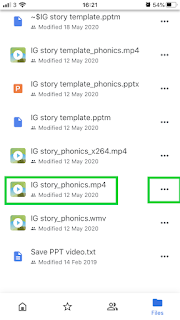


OneDrive, DropBox
For OneDrive, DropBox, etc., go to your phone, find the images, and save them to your phone. They will the appear in your photo storage. From there, upload them to IG as you would any image.
Finally, I tried to upload my IG story video from Chrome to IG using these instructions, but I couldn't get it to work. Maybe you can.
12 May 2020
My work in ELT: Hong Kong / Publishing 1
I remember being thrilled about going to the office at the outset. Getting a key card, being assigned a cubicle and stationery, having my own PC, touring the pantry and copy room, meeting new people … I even got excited taking the elevator. But I am an excitable type, and it was the honeymoon period, and my body was tingling with energy.
The team was small but riding high as Longman had just taken market lead with their new senior secondary course. The future looked good and the team was building; I was the fifth person hired (when I left six years later, the team was 17 people). With all my energy, I was ready to work, but honestly had no idea what to expect. Luckily, in my very first week, we had a three-day training with the Society for Editors and Proofreaders (SfEP). This gave me some idea of what to expect, and oh … there was so much to learn.
I was plopped right in the deep end and assigned the second edition of Grammar Explained, a series for junior secondary 1, 2, and 3. Each book in the course had an extent of nearly 200 pages and I don’t remember how many pieces of line art, but there were a lot. I was given some simple guidelines on how to brief the writer for the changes needed and then set off to work pretty much on my own. I jumped in quickly, probably too quickly, and started splashing ahead. Fortunately, the writer was one of the best for Longman, and that made my life easier, though I didn’t realize it at the time.


Nine months later, the three new editions were complete, out on the market, and doing very well. There had been a growing sense of ownership over the months and I was proud of the product, but boy oh boy, my editorial work was mediocre at best. At the final stages, once someone with experience looked at it, I couldn’t believe how many things I had missed: typos, omissions, stylistic inconsistencies were rife. I remember thinking, ‘Wow! Will I ever get that level where I can zoom and pinpoint things like that?’ But since you’re at my site, I guess you know the answer to that. 😊 It was truly the first time I’d ever worked with lengthy schedules or managed email chains or folder hierarchies/naming standards or manuscript or page proofs and so on. It was manageable but my editorial mindset needed development.
I was a teacher and I understood the importance of critically assessing course material. I’d done that over the years. But as a teacher, I’d worked with people who enjoyed talking about materials and how to solve problems and creative workarounds. And I’m sure I probably drove a couple of editors on the team crazy, asking questions, talking through things, as if I were still teaching. Editors don’t normally do that. We’re too busy! We need to solve problems, move forward, and hold schedules, so we keep our heads down and our keyboards and pens moving.
Other things I remember in those early days were lack of Internet access and red and blue pens. In my early months, we only had email, and then eight or nine months in, we were given one PC on the floor which had Internet access. Then about eight nine months after that, we all got Internet access, which made fact checking a lot easier. And I remember printing MS, marking it up for design, and physically handing a designer the pages and a 3.5 floppy disk with the electronic files. Sure, we used bold for headings and italics for example sentences in the MS, but we still physically marked all of that up … A heads, B heads, indents, italics; what we wanted the realia for text frames to look like (torn newsprint, email, note sheets, posters, etc); where we wanted the artwork set on the physical page or in the realia; suggestions for colours, design, artwork, photos, etc.
Then there were mark-ups page proofs—blue for editorial changes and red for things the design had missed out. Why you ask? Because changes in blue were charged to the editorial team and changes in red were charged to the design team. I have no idea how the money was tracked. And I can’t remember when this practice disappeared or why. Maybe budgeting practices had changed and it was no longer necessary to track who was going to pay for what.
Whew! I’ve rambled on and I’ll
end this by saying that I enjoy looking back at those days. The system seems
primitive, but we still got a heck of a lot done. Now we have Word templates, remote
teams, saving and sharing files in the cloud, marking up PDFs for design; researching
content online, creating parallel products like companion PowerPoints, videos,
blogs learning platforms. These changes have revolutionized ELT publishing in some
ways, for sure. But one thing that hasn’t changed in the issue of time management
and its relationship to quality and people management. More on that next time.
Till then, be well.
04 May 2020
My work in ELT: Hong Kong / Teaching
In the May 1998, I moved to Hong Kong with
the plan of finding a job teaching English. A Native English Teaching (NET) scheme was set to start in September and I had hoped to be part of that. The problem was I didn't have an education degree or a certificate for teaching English as a foreign language, so the Education Bureau (EB) wouldn't even interview me. I called the EB and asked them to interview me, test me—whatever it would take to get my foot in the door. But no. I quickly learned Hong Kong is place where pieces of paper and no amount of experience would get me in the door without the correct degree. Understandable enough, I guess.
So I started looking for students privately by putting up an advert in a local supermarket. Within a couple of weeks, I had a few students and it seemed all would work out. What I found, though, was that my arsenal of lessons from the US didn't work the same here. With private students in the US, I would start with a topic or situation or idea to get students to use the language they already had. My experience has been that students don't appreciate how much English they already know. For me, that was a way to develop rapport, build confidence, and find out where they were on the English ladder and make a plan accordingly.

My private students in the US were from Central and Latin America and I often couldn't shut them up once they started talking, which was fine because there was a lot of 'content' to work with. In HK, I came face to face with the Asian attitude of students not wanting to speak for fear of making a mistake. Of course, I had come across this while teaching in Boston and was used to dealing with it in a classroom environment. But now the classroom had a student of one. I tried games, activities, videos, songs, but 95% of the time, students just weren't engaging.
Teenage students (and their parents) were perfectly happy with me introducing a topic and handing out a grammar worksheet or a short text with questions and sitting passively by while they did they work. When they were finished, we'd talk through mistakes, form, meaning, vocabulary, etc. I tried introducing discussion then and had some success, but the student preference was for paperwork, clearly. I had no issue making or printing worksheets as I of course needed money, but it was terribly boring. And the adults were the same—they wanted to be fed. There's a saying here that says learning is like feeding ducks. So that's what I did.
Luckily, I landed a couple of jobs that involved classroom teaching, one for Kaplan on Saturday mornings and the other at the Japanese International School as an English conversation teacher two mornings a week. With these jobs, I was able to save enough to take a CELTA course at the British Council, which was good fun. My cohort was a potpourri of people—people who had never taught, some retired seniors, but thought they could because English was their native language; people like me, who had some experience, and wanted to open up job opportunities; people in the NET scheme who had degrees in Education (with history or science backgrounds) but didn't know how to teach English.

Teaching was moving along well enough as I took the course, but I still wasn't as happy as I had been in Boston. It was a big move and likely part of my feeling was due to culture shock. I slowly began to think that maybe I should for another type of work, but what. So one day in late October 1999 I asked Google 'possible jobs for an English language teacher' and ELT editor came up in the search results. I researched job descriptions for ELT editors and thought, 'Hey, that sounds like fun.'
I updated my CV, registered at some job databases, and started reading the classifieds. Then just as I finished my CELTA course in mid-November 1999, a job advert for an ELT Editor at Longman Hong Kong (now Pearson) turned up. I went in for a test and an interview, got a call back for a second interview (a first for me at the time), was offered a job, and landed at my first desk job on 3 January 2000.
So I started looking for students privately by putting up an advert in a local supermarket. Within a couple of weeks, I had a few students and it seemed all would work out. What I found, though, was that my arsenal of lessons from the US didn't work the same here. With private students in the US, I would start with a topic or situation or idea to get students to use the language they already had. My experience has been that students don't appreciate how much English they already know. For me, that was a way to develop rapport, build confidence, and find out where they were on the English ladder and make a plan accordingly.

My private students in the US were from Central and Latin America and I often couldn't shut them up once they started talking, which was fine because there was a lot of 'content' to work with. In HK, I came face to face with the Asian attitude of students not wanting to speak for fear of making a mistake. Of course, I had come across this while teaching in Boston and was used to dealing with it in a classroom environment. But now the classroom had a student of one. I tried games, activities, videos, songs, but 95% of the time, students just weren't engaging.
Teenage students (and their parents) were perfectly happy with me introducing a topic and handing out a grammar worksheet or a short text with questions and sitting passively by while they did they work. When they were finished, we'd talk through mistakes, form, meaning, vocabulary, etc. I tried introducing discussion then and had some success, but the student preference was for paperwork, clearly. I had no issue making or printing worksheets as I of course needed money, but it was terribly boring. And the adults were the same—they wanted to be fed. There's a saying here that says learning is like feeding ducks. So that's what I did.
Luckily, I landed a couple of jobs that involved classroom teaching, one for Kaplan on Saturday mornings and the other at the Japanese International School as an English conversation teacher two mornings a week. With these jobs, I was able to save enough to take a CELTA course at the British Council, which was good fun. My cohort was a potpourri of people—people who had never taught, some retired seniors, but thought they could because English was their native language; people like me, who had some experience, and wanted to open up job opportunities; people in the NET scheme who had degrees in Education (with history or science backgrounds) but didn't know how to teach English.

Teaching was moving along well enough as I took the course, but I still wasn't as happy as I had been in Boston. It was a big move and likely part of my feeling was due to culture shock. I slowly began to think that maybe I should for another type of work, but what. So one day in late October 1999 I asked Google 'possible jobs for an English language teacher' and ELT editor came up in the search results. I researched job descriptions for ELT editors and thought, 'Hey, that sounds like fun.'
I updated my CV, registered at some job databases, and started reading the classifieds. Then just as I finished my CELTA course in mid-November 1999, a job advert for an ELT Editor at Longman Hong Kong (now Pearson) turned up. I went in for a test and an interview, got a call back for a second interview (a first for me at the time), was offered a job, and landed at my first desk job on 3 January 2000.
29 April 2020
My work in ELT: Boston / English Language Center
After Seoul, I travelled some and
returned to the US in May of 1993. I took time to relax, catch up with family
and friends, and travel around the US. I then decided to settle in Boston, a
couple of hours from my hometown, and was fortunate to find a place to live and
a teaching job within a couple of weeks. The ELC (English Language Center) was
much like the school in Seoul but classes—grammar, conversation, reading and
writing—ran from 8.30 to 3.30 every day. Students were aged from 16 to whenever,
and my oldest student, Mr Kwan from South Korea, was 72.
 I enjoyed the teaching and
students immensely, but I had a lot to learn. I remember one day being in the
middle of a lower intermediate grammar class (Azar’s Fundamentals of English
Grammar) and having students give me the look of death—boredom. I felt a
pain in my chest that day and knew I had to do something to up my game. And so
it began—studying and parsing the grammar so that I could go into class with
simple or step-by-step explanations. This along with pair or group work/feedback
for activities, asking students to explain answers, finding ways to play games
with the grammar, etc.
I enjoyed the teaching and
students immensely, but I had a lot to learn. I remember one day being in the
middle of a lower intermediate grammar class (Azar’s Fundamentals of English
Grammar) and having students give me the look of death—boredom. I felt a
pain in my chest that day and knew I had to do something to up my game. And so
it began—studying and parsing the grammar so that I could go into class with
simple or step-by-step explanations. This along with pair or group work/feedback
for activities, asking students to explain answers, finding ways to play games
with the grammar, etc.
I started breaking down other
lessons into smaller steps as well, e.g. vocabulary needed for a reading text,
structures needed for conversation or writing, steps needed to achieve a
conversation task. I also made a conscious decision, especially in conversation
classes, to talk as little as possible, that is, to get students set up as
quickly as possible, let them practice, as I listened, supported, noted,
corrected as necessary. In doing this, I discovered a method for myself that I
later learned was called PPP (Present, Practice, Produce) which was also
related to TTT (Teacher Talking Time).
Life was good at the ELC and I
started experimenting with video in the classroom for prediction, sequencing, writing
conversations, gap-filling, role plays, and so on. I also started looking at
ways to more closely link reading and writing. Why are we reading this text?
What do students need to understand about it? Are there features of grammar or
language that help us understand what this text is? How do I want students to
respond the text? Should they imitate it, summarize it, paraphrase it, respond
to it, agree or disagree with it, add to it, transform it’s register? I was
super excited to be experimenting, trying different things, and classes ended
up being great fun. I remember my boss at the time asked me to put together a
reading/writing pack. I went way overboard, printing copies of more than 100
texts, all with ideas for reading and writing.
While at the ELC, I also arranged
and taught English writing/grammar classes at the Boston Conservatory of Music.
This was an arrangement between the conservatory and the ELC. The classes were
three mornings a week at 8 a.m. and they weren’t easy. Students were often
absent, tardy, distracted, tired. It was understandable, of course, as they
wanted to focus on their instrument or art, but the theory or basic language
arts courses required writing research papers about a musical composition, a
composer, or The Iliad. I was given a composition book to teach with at
first, but it was too compartmentalized and very heavy on teaching language. I
also tried to talk to the teachers to get an idea of the issues they were
seeing in the classroom. A couple of them were open with me, helpful, while
others were busy or even resistant to talking to me.
With the permission of the Head of
International Students, I switched to teaching a mix of grammar and writing and
tried using group work, tasks. But the students didn’t connect like the ones at
the ELC. Maybe their focus was somewhere else, or with so many absentees, they
just weren’t invested. I couldn’t find a way to make any ground. I was unable
to find a solution and that frustrated me.
 I talked with the head and wondered
if the students weren’t talking the class seriously partly because it was seen
as an extra class taught by an extra teacher. I was frustrated and wanted out
and was looking for solutions. I encouraged her to hire a part-time English
teacher for the school, someone who would be considered part of the part of the
staff and maybe the English writing programme could be integrated and aligned
with the academic classes. She said she’d think about it.
I talked with the head and wondered
if the students weren’t talking the class seriously partly because it was seen
as an extra class taught by an extra teacher. I was frustrated and wanted out
and was looking for solutions. I encouraged her to hire a part-time English
teacher for the school, someone who would be considered part of the part of the
staff and maybe the English writing programme could be integrated and aligned
with the academic classes. She said she’d think about it.
What the head did was hire an
English Coordinator to assess the situation and one day the coordinator popped
in to see a class. And what a day it was. Five of 12 students were absent and I
was disappointed because homework hadn’t been done. I assigned three pages of
grammar exercises as a kind of punishment. Not very exciting. And worse, when
we were revising the answers, I found I was unable to explain the grammar (advanced
relative clauses) clearly. It was definitely not a nice class to observe and I believe
it expedited the decision to hire an English teacher to be on the conservatory staff.
I look back on my time there as a
failure. I was hired to do teach a class and I couldn’t make it work they way I
had with classes at the ELC. When I returned to my normal schedule at the ELC,
I decided to level up and asked to teach advanced grammar lessons. It was an
area in which I was lacking and a good way to move forward is to teach what you
need to learn. It went well. I learned a ton and fortunately didn’t embarrass myself
too much with students.
Subscribe to:
Posts (Atom)
-
And here's another phonics lesson, hard C/K & G sounds. This is an embedded Microsoft Office presentation, powered by Office .
-
 Hello! Here's a present simple worksheet that you can use for self-learning as answers are included. Or you can use it in the classroom ...
 -
Hello! Here's a present continuous worksheet that you can use for self-learning as answers are included. Or you can use it in the clas...